IPTV TV (Internet Protocol Television) is a method of delivering live television channels and on-demand video content over an internet connection rather than traditional terrestrial, satellite, or cable broadcast formats. In plain terms: instead of receiving signals through a coaxial cable or satellite dish, IPTV streams video as data packets directly to your device through your broadband connection.
The technology has moved from niche to mainstream over the past five years, driven by faster home internet speeds and the accelerating cord-cutting movement. By 2026, IPTV represents the most cost-effective way to access global channel lineups, premium sports packages, and 4K HDR content — but only when you know how to identify legitimate providers. This guide delivers the complete breakdown of what IPTV TV is, how it works, and whether it deserves a place in your home.
Executive Summary: What Iptv Tv
Best For
Cord-cutters & international households seeking budget-friendly live TV and global sports without long-term contracts
Standout Feature
Streams live TV and on-demand content in up to 4K HDR over any standard broadband connection — no satellite dish or coaxial cable required
- ✓ IPTV TV delivers live and on-demand video over your internet connection, eliminating the need for traditional cable infrastructure entirely.
- ✓ Legitimate IPTV services cost $15–$80/month compared to $100+ for cable, with no equipment rental fees or hidden taxes.
- ✓ Setup takes under 15 minutes on Smart TVs, Android boxes, Fire Sticks, or mobile devices with a stable 25 Mbps connection.
Quick Navigation
What Is IPTV TV? The Core Definition
IPTV stands for Internet Protocol Television. It's a system where television services are delivered using the internet protocol suite over a packet-switched network — the same networking architecture that powers the public internet and private data networks.
Unlike traditional broadcasting methods that push signals to everyone at once (broadcast), IPTV pulls content only when you request it (unicast) or streams it efficiently to multiple viewers in real time (multicast). This fundamental shift changes how television is delivered, consumed, and paid for.
IPTV services typically fall into three categories:
- Live Television — Broadcast channels streamed in real time, including sports, news, and entertainment channels from around the world.
- Time-Shifted Television — Catch-up TV services that let you rewind, pause, or replay broadcast content after it airs.
- Video on Demand (VOD) — A library of movies and series you can watch at any time, similar to Netflix but often bundled within the IPTV subscription.
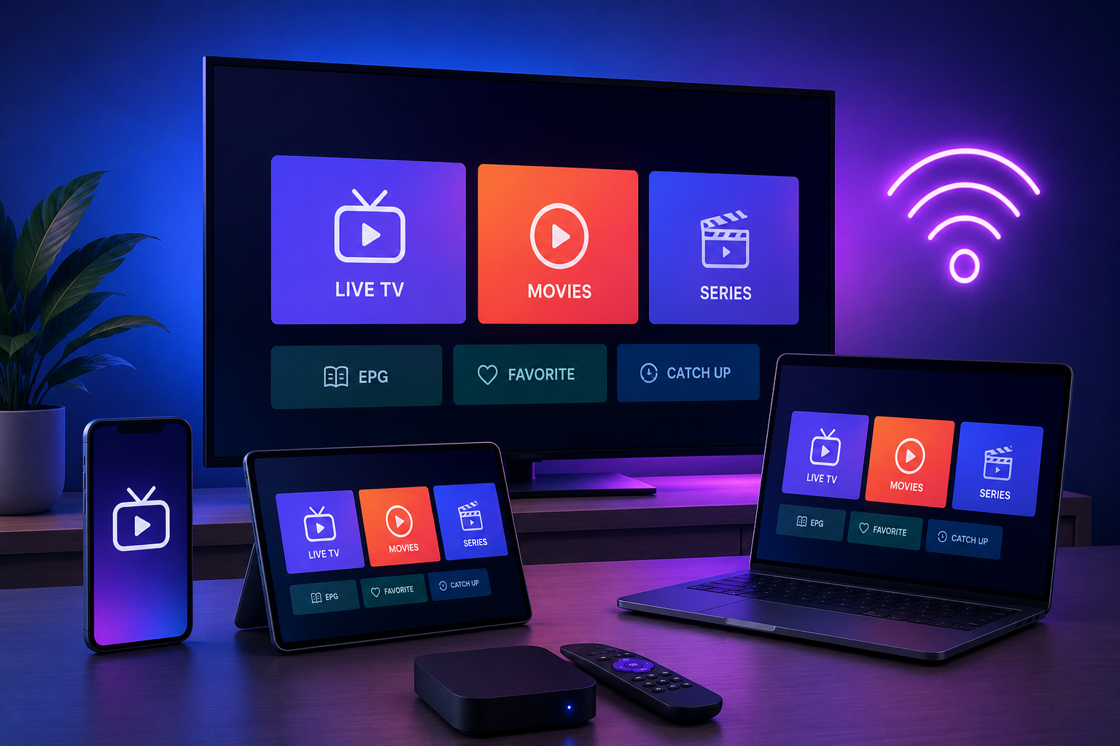
In practice, a modern IPTV subscription gives you a unified interface — typically an EPG (Electronic Program Guide) — where live channels, VOD libraries, and recorded content are all accessible from one screen.
How IPTV Works: The Technical Mechanics
Related Reading: Dice Dreams Free Rolls: Honest Review & Daily Links 2026
The mechanics behind IPTV are straightforward but important to understand when evaluating providers.
Step 1: Content Acquisition. IPTV providers acquire channel feeds and VOD content through licensing agreements with broadcasters, studios, and sports leagues. Legitimate providers pay for these rights; pirated services do not.
Step 2: Encoding and Transcoding. The video feeds are compressed into modern codecs (H.264, H.265/HEVC, AV1) and segmented into small data chunks. Different bitrate profiles are created so the same content can be delivered in SD, HD, FHD, or 4K depending on your internet speed.
Step 3: Delivery via CDN. The segmented content is distributed across content delivery networks (CDNs) with servers in multiple geographic regions. When you hit play, your device connects to the nearest server, reducing latency and buffering.
Step 4: Player/App Decoding. On your end, an IPTV app or player receives these packets, reassembles them in order, decodes the video, and displays it on your screen. Apps like IPTV Smarters Pro, TiviMate, and IBO Player are popular choices.
Key protocols used: RTSP for live streaming, RTP for real-time data transport, and HLS/DASH for adaptive bitrate streaming.
The practical takeaway: your internet connection quality directly determines your IPTV experience. A stable 25 Mbps connection handles 4K streams; anything slower causes buffering, quality drops, or channel load failures.
what is iptv tv
Get instant access to 20,000+ live channels, premium sports, and 4K movies — streamed directly to any device for a fraction of cable's cost.
What's Included:
- ✓ 20,000+ live international channels in HD, FHD & 4K
- ✓ 99.9% uptime server reliability with zero-buffer streaming
- ✓ 24/7 customer support and 24-hour money-back guarantee
Guaranteed authentic checkout directly from the manufacturer.
IPTV vs. Cable vs. Streaming: Full Comparison
Now let's see how IPTV stacks up against cable and OTT streaming services like Netflix, Hulu, or YouTube TV.
| Feature | IPTV TV | Cable TV | OTT Streaming |
|---|---|---|---|
| Delivery Method | Managed IP network | Coaxial cable | Public internet (unmanaged) |
| Live TV Channels | Yes, including global | Yes (regional only) | Limited (live add-ons) |
| 4K HDR Support | Yes (up to 4K) | Limited (on demand only) | Yes (select content) |
| Monthly Cost Range | $10–$80 | $75–$200+ | $7–$75 (aggregated) |
| Hardware Required | Smart TV / box + internet | Cable box + coaxial | Any internet device |
| Contract Required | No (monthly plans) | Yes (1–2 year typical) | No |
| Channel Selection | 500–30,000+ channels | 200–400 channels | Content library-based |
| Setup Time | Under 15 minutes | Professional installation | Under 10 minutes |
Analysis: IPTV wins decisively on channel selection, price, and hardware flexibility. Cable's only remaining advantages are its perceived reliability and simplicity for older users. OTT streaming wins on original content but falls short on live TV coverage and global channel access. For anyone who values live television and international programming, IPTV is the clear value champion.
Types of IPTV Services You Need to Know
Related Reading: pineal xt: Complete Guide - Everything You Need to Know
Not all IPTV is the same. Here are the three types you'll encounter in the market:
- Licensed telecom IPTV — Offered by companies like AT&T TV, Verizon Fios, and European telecoms. These are fully legal, licensed services. Typically $50–$150/month.
- OTT streaming services — Hulu + Live TV, YouTube TV, Sling TV. These are technically OTT, not pure IPTV, but use similar IP delivery mechanics. $40–$80/month.
- Third-party / specialized IPTV subscriptions — Independent providers like those reviewed on iptvstreampulse.com that aggregate international channels, sports packages, and VOD libraries at aggressive price points. Quality and legality vary wildly by provider — stick to verified services with active licensing.
Legal IPTV vs. Pirated IPTV: Critical Distinctions
This is the most critical distinction to understand before subscribing.
Legal IPTV providers operate with proper licensing. They pay broadcasters and content owners for the right to distribute channels. Examples include AT&T TV, Hulu + Live TV, YouTube TV, and verified third-party providers.
Pirated IPTV services illegally rebroadcast premium channels and pay-per-view events without authorization. Red flags include:
- Prices that seem impossibly low (less than $10/month for "all channels")
- No company registration or physical address
- No licensing documentation available
- Payment only via crypto or untraceable methods
- App not available on official app stores
The risks of pirated IPTV go beyond legal exposure: malware, phishing, data theft, unreliable uptime, and service disappearing overnight. If you're considering an independent IPTV provider, always verify licensing, read reviews, and use a provider with transparent ownership and customer support.
What You Need to Get Started with IPTV
Related Reading: Free Nintendo eShop Codes: Legit Ways to Get Them in 2026
Here's the minimum requirement checklist:
Internet Connection:
- SD streaming: 10 Mbps minimum
- HD streaming: 15–25 Mbps
- 4K streaming: 25–50 Mbps stable, no data caps
Device Options:
- Smart TV (Samsung, LG, Android TV, Roku) with IPTV app
- Amazon Fire TV Stick 4K
- Android TV box
- iOS/Android tablet or phone
- PC/Mac (VLC, Kodi, or browser-based players)
Setup Steps: Purchase a subscription and receive credentials via email. Install a compatible IPTV player app. Enter the server URL, username, and password. Allow the EPG to load — the full channel list appears. Start watching.
Most users complete setup in under 15 minutes.
Cost-Benefit Analysis of IPTV in 2026
Monthly cost comparison:
- Cable: $100–$200+ (plus $10–$15/month box rental, taxes, fees)
- OTT stack (Hulu + Live TV, Netflix, Max, sports add-on): $85–$130/month
- Legitimate IPTV: $10–$80/month — no box rental, no hidden fees
Annual savings with IPTV: If you're switching from cable at $150/month to IPTV at $30/month, that's $1,440/year in savings. Over 3 years, you save $4,320 — enough to pay for a new 65" 4K TV.
The trade-off: IPTV services vary in reliability. You need a stable internet connection and should avoid budget providers with poor uptime. The best providers offer 99.9% uptime SLAs and multi-server failover — well worth the $5–$10/month premium over the cheapest options.
The Ideal IPTV User Profile
IPTV is ideal for:
- Cord-cutters who want live TV without long-term contracts
- International households seeking home-country channels
- Sports fans who want global sports packages (Premier League, NBA, UFC, cricket)
- Budget-conscious consumers tired of cable inflation
- Renters who can't install satellite dishes
IPTV is NOT ideal for:
- People with unstable or capped internet connections
- Users who only watch Netflix and don't need live channels
- Those unwilling to set up a player app (minimal tech literacy)
Pros and Cons of IPTV TV
Pros:
- 60–80% cost savings vs. cable
- 10,000+ global channels
- No long-term contracts
- Multi-device support
- 4K HDR quality
- Instant setup
- Portability (watch anywhere with internet)
Cons:
- Requires reliable broadband (25 Mbps+)
- Quality varies between providers
- Legal gray area with unverified providers
- EPG/user interface quality varies
- No offline recording on some services
Our Clear Verdict on What Iptv Tv
For households paying $100+ per month for cable, IPTV TV delivers the same live channels, global programming, and premium sports at 60–80% lower cost. If you value flexible streaming, international content, and 4K quality, ordering from a verified IPTV provider is the highest-ROI television decision you can make in 2026.
Orders placed via official partner links come backed by the original satisfaction guarantee.
Frequently Asked Questions
Is IPTV TV legal in the United States?
Yes, IPTV is legal in the US when the provider holds proper content licensing. Fully licensed services like AT&T TV and YouTube TV operate legally. Unlicensed third-party services that rebroadcast premium content without authorization operate illegally — you should avoid those entirely.
What internet speed do I need for IPTV?
For HD streaming, a stable 15 Mbps connection is sufficient. For 4K UHD content, you'll want at least 25–50 Mbps. Also ensure your connection has no data caps, as heavy IPTV usage can consume 100–300 GB per month.
Can IPTV completely replace cable TV?
Yes, for most users. IPTV provides live channels, sports, news, and VOD. If you have reliable broadband, IPTV can replace cable entirely at a fraction of the cost. The main requirement is consistent internet speed and a compatible device.
What equipment is required for IPTV?
A Smart TV, Amazon Fire Stick, Android box, or mobile device, plus a valid IPTV subscription. No technician installation, satellite dish, or coaxial cable needed.
What's the difference between IPTV and OTT streaming services like Netflix?
IPTV typically operates over a managed, private network with guaranteed bandwidth (especially with telecom providers). OTT (Over-The-Top) services like Netflix deliver over the public internet without quality guarantees. Both use IP delivery — the distinction is the network infrastructure and content delivery model.
Can I watch IPTV on my Smart TV?
Yes. Most Smart TVs support IPTV through apps like IPTV Smarters Pro, TiviMate, or provider-specific apps. Samsung and LG TVs with webOS support them; Android TV and Fire TV devices are also fully compatible.
How much does a legitimate IPTV subscription cost per month?
Licensed services range from $40–$80/month (YouTube TV, Hulu + Live TV). Independent verified providers with international channel packages typically charge $15–$30/month. Avoid anything under $10/month — it's almost certainly pirated.
How do I identify a safe, legitimate IPTV provider?
Look for transparent company information, verifiable licensing, payment via standard methods (credit card/PayPal), official app store availability, responsive customer support, and positive independent reviews. Avoid providers that only accept crypto and offer "all channels for $5/month."
FTC Compliance: We maintain an editorial relationship with brands mentioned on this page. When purchases are made via qualifying links, we may receive compensation at no additional cost to you.