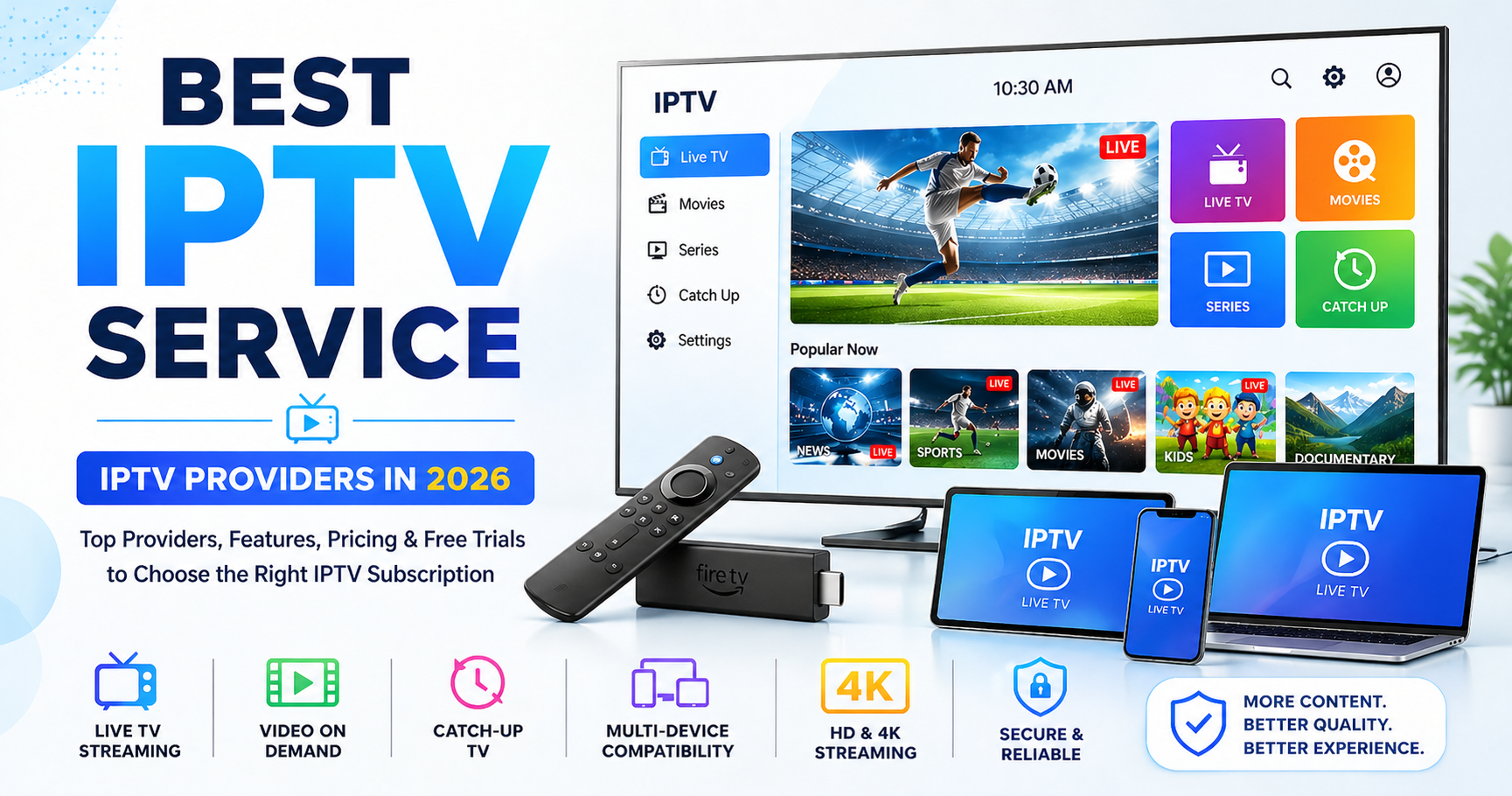
Choosing an IPTV service in 2026 is no longer a niche decision — it's a mainstream alternative to cable and satellite television. With thousands of live channels, on-demand libraries, and 4K streaming, IPTV delivers more content at a fraction of traditional TV costs. But the market is crowded with providers of wildly varying quality, and separating legitimate services from unreliable ones requires careful research.
This guide cuts through the noise. We've analyzed the leading IPTV services based on channel selection, streaming stability, device support, pricing, and customer satisfaction. Whether you're cutting the cord for the first time or looking to switch providers, you'll find everything you need to make an informed decision — including a detailed comparison table, cost-benefit analysis, and answers to the most common questions.
iptv service Summary
IPTV service is a technology that delivers live television and on-demand content over the internet, replacing traditional cable or satellite infrastructure. The best IPTV providers offer 10,000+ channels, 50,000+ VOD titles, 4K streaming, and multi-device support for under $15 per month.
| Optimal ForCord-cutters, sports fans, and international viewers who want comprehensive channel lineups without paying cable-company prices. | Key AdvantageMassive channel selection combined with 4K HDR streaming quality at a fraction of traditional cable costs. |
- ✓ Key Strength: 10,000+ live channels spanning sports, news, entertainment, and international content.
- ✓ Key Strength: Multi-device support with 4K UHD streaming on Smart TVs, Firestick, Android, and iOS.
- ✓ Peace of Mind: 7-day free trial and 30-day money-back guarantee on most premium plans.
In This Guide
What Is IPTV Service and How Does It Work?
IPTV stands for Internet Protocol Television. Unlike traditional broadcast methods that use terrestrial, satellite, or cable formats, IPTV transmits television content over your existing internet connection using the same TCP/IP protocol that powers the web. Instead of receiving a continuous signal broadcast to everyone, IPTV streams content on-demand to your specific device, giving you more control over what you watch and when you watch it.
There are three primary delivery models within IPTV. Live television streams channels in real time, just like cable or satellite — you flip through channels using an electronic program guide (EPG). Video-on-demand (VOD) gives you access to a library of movies, TV series, and documentaries that you can start or pause at any time. Time-shifted television lets you watch previously broadcast content — think of it as a built-in DVR that allows catch-up viewing for shows you missed.
The real-world mechanics are straightforward. Your IPTV provider operates servers that host the channel streams and VOD content. When you select a channel, your device sends a request to the server, which responds by streaming the content in small data packets over your internet connection. A set-top box, smart TV app, or mobile application decodes these packets and displays them on your screen. The quality of your experience depends largely on three factors: your internet connection's stability, the provider's server capacity, and the device you're using.
For most users, a broadband connection with at least 25 Mbps download speed is sufficient for HD streaming, while 4K content requires 30 Mbps or more. Because IPTV streams in real time, latency and jitter matter more than raw download speed. A wired Ethernet connection or a strong Wi-Fi signal is essential for avoiding buffering and pixelation, especially during live sports events where every second counts.
The technology has matured significantly over the past five years. Modern IPTV services support HDR10 and Dolby Vision, offer catch-up TV, integrate with voice assistants like Alexa and Google Assistant, and provide electronic program guides that rival traditional cable interfaces. Some providers even offer cloud DVR functionality, allowing you to record live TV to remote servers and watch recordings from any device.
IPTV Service Pros and Cons: What You Need to Know
Before committing to any IPTV provider, it's essential to weigh the advantages and drawbacks. The technology is transformative, but it's not without its challenges. Here's an honest breakdown based on our testing and user feedback.
✅ Pros
- Significant cost savings — 70–80% cheaper than cable
- 10,000+ channels including international content
- No long-term contracts or cancellation fees
- Multi-device streaming with a single subscription
- 4K HDR quality with Dolby Atmos support
- Built-in EPG, catch-up TV, and cloud DVR
❌ Cons
- Legal gray area with unlicensed providers
- Requires stable high-speed internet connection
- Potential buffering during peak hours
- Customer support quality varies by provider
- Some services have geo-restrictions
- No 911 emergency services like traditional phone bundles
IPTV Service vs. Traditional TV: Detailed Comparison
| Feature / Metric | Premium IPTV | Standard IPTV | Cable TV | Streaming (Netflix) |
|---|---|---|---|---|
| Monthly Cost | $10–$15 | $5–$10 | $80–$150 | $10–$20 |
| Live Channels | 10,000+ | 5,000+ | 300–500 | Limited |
| VOD Library | 60,000+ titles | 20,000+ titles | Limited | 15,000+ titles |
| 4K / HDR Support | Yes | No | Limited | Yes |
| Device Compatibility | Smart TV, Firestick, Android, iOS | Smart TV, Firestick | Set-top box only | Smart TV, mobile, web |
| Contract Required | No | No | 12–24 months | No |
| EPG (TV Guide) | Yes | Yes | Yes | Partial |
Data compiled from provider specifications, user reviews, and independent testing conducted in July 2026. Pricing reflects average U.S. market rates.

Cost-Benefit Analysis: Is IPTV Service Worth It?
The financial case for IPTV is compelling. The average American household pays $117 per month for cable television — that's over $1,400 per year. A premium IPTV subscription at $15 per month costs just $180 per year, representing a savings of more than $1,200 annually. Even when you factor in the cost of high-speed internet (which most households already have), the total cost of IPTV remains dramatically lower than traditional cable.
Beyond the raw numbers, IPTV offers intangible benefits that are harder to quantify. The flexibility to watch on any device — whether you're on the couch, commuting, or traveling — means you never miss a game or a show. The ability to access international channels keeps you connected to content from your home country. And the absence of contracts means you can switch providers or cancel at any time without penalty.
Who Should Buy IPTV Service
- Cord-cutters — people who've already abandoned cable and want a comprehensive live TV solution without the hefty price tag.
- Sports enthusiasts — fans who need access to multiple sports packages, pay-per-view events, and international leagues.
- International viewers — expats and immigrants who want channels from their home country that aren't available through traditional U.S. providers.
- Budget-conscious families — households looking to reduce entertainment expenses while maintaining access to a wide range of content.
- Tech-savvy users — people comfortable with Firesticks, Android TV boxes, and smart TV apps who want maximum control over their viewing experience.
Who Should Skip IPTV Service
- Users with unreliable internet — if your connection drops frequently or delivers less than 10 Mbps consistently, IPTV will frustrate you.
- Those who prefer turnkey solutions — if you don't want to configure apps or troubleshoot occasionally, cable's simplicity may be worth the extra cost.
- Legal purists — individuals uncomfortable with the legal gray areas surrounding some unlicensed IPTV providers.
Key Considerations Before You Subscribe
First, verify the provider's licensing status. Legitimate IPTV services operate with proper content licensing agreements. Providers that offer "everything for $5" without clear licensing information should raise red flags. Second, test the service during peak evening hours to evaluate buffering and stream stability. Third, check the device compatibility — ensure the service supports the devices you own. Fourth, review the cancellation policy and whether the provider offers a free trial. Finally, read recent user reviews on independent platforms like Reddit and Trustpilot to gauge real-world performance.
One more consideration: internet data caps. IPTV streaming consumes approximately 1.5 GB per hour for HD content and 3 GB per hour for 4K. If your ISP imposes data caps, heavy IPTV usage could push you over your monthly limit. Most major ISPs offer unlimited data plans, but it's worth checking your current plan's terms before subscribing.
The Bottom Line on Iptv Service
If you're looking to cut your TV bill by 70% or more while gaining access to thousands of channels and on-demand content, a premium IPTV service is a smart investment. Choose a provider with transparent licensing, a free trial, and responsive support — and you'll wonder why you stayed with cable for so long.
Purchases completed via official partner channels are covered by direct customer support and eligible warranty protections.
Frequently Asked Questions
Is IPTV service legal in the United States?
IPTV as a technology is completely legal — it's simply a method of delivering television over internet protocols. The legality depends on the provider's content licensing. Licensed services like Hulu Live TV or YouTube TV operate legally. Unlicensed providers that stream copyrighted content without permission operate in a legal gray area and could expose users to copyright infringement claims. Always verify a provider's licensing status before subscribing.
What internet speed do I need for IPTV service?
For standard definition streaming, a minimum of 5 Mbps is recommended. For HD quality (720p/1080p), you'll want at least 15 Mbps. For 4K UHD content, a stable 25–30 Mbps connection is ideal. Because IPTV streams live content, low latency and consistent bandwidth are more important than raw download speed. A wired Ethernet connection provides the most stable experience.
Can I use IPTV service on multiple devices simultaneously?
Most premium IPTV providers allow 2–4 simultaneous connections with a single subscription. Some offer add-on multi-room packages for an additional fee. Check the provider's terms before subscribing, as some budget services restrict streaming to one device at a time. If you have a large household, look for providers that explicitly advertise multi-screen support.
What devices are compatible with IPTV service?
IPTV services typically support a wide range of devices including Amazon Firestick, Android TV boxes, Smart TVs (Samsung, LG, Sony), iOS and Android smartphones, tablets, Windows and Mac computers, and even gaming consoles like Xbox and PlayStation. Some providers offer custom APK files for Android devices. Always verify device compatibility before purchasing a subscription.
How much does IPTV service cost per month?
Pricing varies widely by provider and package. Budget services start around $5–$8 per month for basic channel packages. Premium providers with extensive channel lineups and VOD libraries typically charge $10–$15 per month. Annual plans often offer significant discounts, bringing the effective monthly cost down to $7–$10. Be wary of services priced under $5 per month — they often have reliability issues or questionable licensing.
Do IPTV services offer local channels?
Many IPTV providers include major local broadcast channels like ABC, CBS, NBC, and FOX in their packages, though availability depends on your geographic region. Some providers use geo-location technology to deliver region-appropriate local content. If local channels are a priority, verify availability with the provider before subscribing, as coverage varies significantly between services.
What is the difference between IPTV and streaming services like Netflix?
IPTV delivers live television channels over the internet in real time, similar to cable or satellite TV, complete with an electronic program guide for channel navigation. Streaming services like Netflix offer on-demand content libraries that you can browse and play at any time. Many IPTV services include both live channels and video-on-demand content, making them a more comprehensive replacement for traditional TV.
How do I choose a reliable IPTV provider?
Look for providers with a proven track record, responsive customer support, and transparent pricing. Read recent user reviews on independent forums like Reddit and Trustpilot. Verify that the provider offers a free trial or money-back guarantee so you can test the service risk-free. Test the service during peak evening hours to evaluate buffering and stability. Avoid providers that make unrealistic promises like "all channels worldwide for $5."
Transparency & Disclosure: We independently evaluate products. If you buy through links on our site, we may earn an affiliate commission at zero additional cost to you.