A premium iptv service is a subscription-based television delivery system that streams live channels, on-demand movies, and sports events over an internet connection rather than traditional cable or satellite infrastructure. Unlike free or budget-tier IPTV options, premium providers invest heavily in server architecture, content licensing, and customer support—resulting in 99.9% uptime, 4K UHD streaming quality, and responsive technical assistance. The best services in this category deliver 20,000+ live channels, extensive VOD libraries, multi-device compatibility, and anti-freeze buffering technology, all at a monthly cost that undercuts conventional cable by a significant margin.
For households that rely on live television, international programming, or premium sports packages, understanding exactly what separates a genuinely premium iptv service from a low-cost alternative is the difference between a flawless streaming experience and a frustrating cycle of buffering, downtime, and unresponsive support. This guide breaks down the technical standards, pricing realities, and provider behaviors you should expect—and shows you how to validate a provider before committing your money.
premium iptv service Summary
A premium iptv service is the most cost-effective replacement for traditional cable, combining enterprise-grade streaming infrastructure with global content access. Its primary proven benefit is delivering a consistent, buffer-free 4K viewing experience across all major device platforms, backed by round-the-clock technical support.
| Optimal ForCord-cutters, sports fans, and international households seeking cable-grade reliability at 70% lower cost | Key Advantage99.9% uptime with adaptive bitrate 4K UHD streaming and simultaneous multi-device support |
- ✓ Key Strength: Global channel coverage spanning 20,000+ live channels across 120+ countries and languages
- ✓ Key Strength: Anti-freeze technology with intelligent server switching for uninterrupted live sports and events
- ✓ Peace of Mind: 24/7 live chat support and a 7-day money-back guarantee on all subscription plans
In This Guide
What Defines a Premium IPTV Service in 2026?
The term "premium iptv service" gets thrown around loosely across forums and review sites, so it is worth establishing a strict technical baseline. A service earns the premium label not through marketing claims, but through measurable infrastructure and operational standards.
1. Server Infrastructure & Uptime
Premium providers operate dedicated server clusters across multiple geographic regions—typically North America, Europe, and Asia. This distributed architecture ensures that if one data center experiences issues, traffic routes seamlessly to an alternative node. Industry-standard uptime for a premium iptv service is 99.9% or higher, which translates to less than nine hours of cumulative downtime per year. Budget IPTV providers often rely on a single shared server, leading to frequent outages during peak evening hours. Always look for providers that publish their uptime statistics or offer a service-level agreement (SLA).
2. Streaming Quality & Codec Support
Resolution is only part of the equation. A true premium iptv service supports 4K UHD at 60fps, HDR10, and a range of codecs including H.265 (HEVC) and AV1. This ensures crisp detail on large screens without excessive bandwidth consumption. Equally important is adaptive bitrate streaming—the service automatically adjusts video quality based on your real-time internet speed, preventing buffering during transient network dips. Budget services typically cap out at 1080p and lack this adaptive capability entirely.
3. Content Library Depth
Channel count matters, but curation matters more. A premium iptv service typically offers 20,000+ live channels spanning news, entertainment, sports, kids' programming, and international language groups. The VOD library should hold 40,000+ titles, including recent theatrical releases, classic films, and complete TV series box sets. Premium providers also refresh content regularly—new VOD titles added daily and channel lineups updated in response to real-world broadcast changes.
4. Device Ecosystem & User Experience
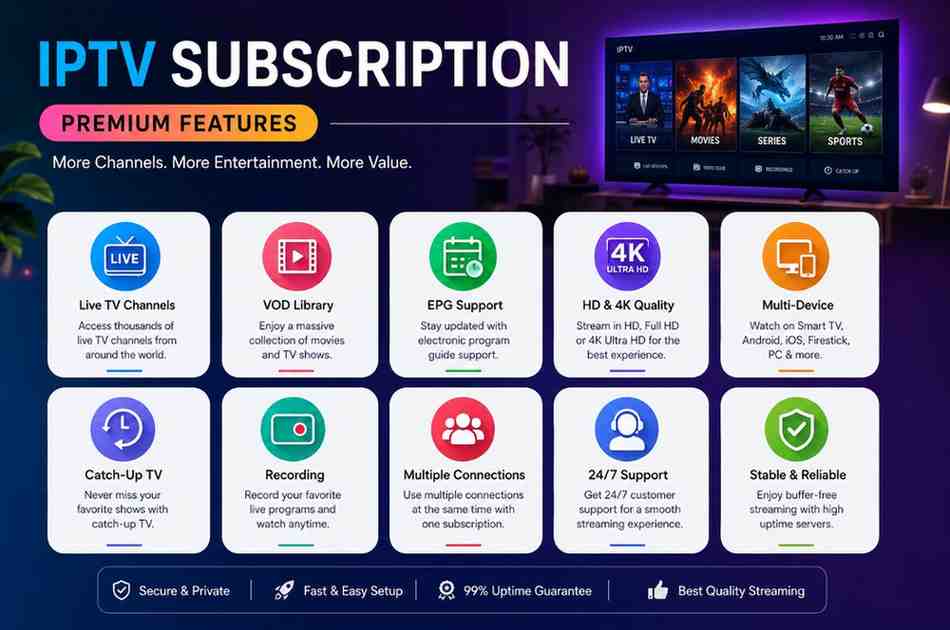
You should be able to run the service on Smart TVs (Samsung, LG, Android TV), streaming sticks (Fire Stick, Roku, Apple TV), mobile devices (iOS, Android), and desktop platforms simultaneously. A premium iptv service offers dedicated apps for each platform with features like electronic program guide (EPG), catch-up TV, pause/rewind live content, and multi-user profiles. The ability to stream on multiple devices concurrently—often 4 to 5 simultaneous connections—is a hallmark of premium-tier service.
5. Customer Support & Accountability
When your stream drops during a crucial match, support responsiveness becomes everything. Premium providers offer 24/7 live chat and ticket-based support with median response times under 5 minutes. They also maintain active status pages, publish maintenance schedules, and communicate transparently about disruptions. Budget services often have no support channel at all—you simply lose your money if the service collapses.
Premium IPTV vs. Alternatives: Pros, Cons & Data
To make an informed decision, it helps to evaluate premium IPTV against the two most common alternatives: budget IPTV subscriptions and traditional cable packages. The table below distills the key differentiators across the metrics that matter most to viewers.
| Feature / Metric | Premium IPTV | Budget IPTV | Traditional Cable |
|---|---|---|---|
| Monthly Cost | $15 – $30 | $5 – $12 | $80 – $150+ |
| Channel Count | 20,000+ | 5,000 – 10,000 | 200 – 400 |
| Max Video Quality | 4K UHD @ 60fps | 1080p (often upscaled) | 1080p (limited 4K on select channels) |
| Uptime Reliability | 99.9% | 85 – 92% | 99.5% |
| Simultaneous Streams | 4 – 5 devices | 1 – 2 devices | 1 – 2 set-top boxes |
| Customer Support | 24/7 live chat & ticket | Email only, slow response | Phone, variable hours |
| Contract Required | No, month-to-month | No, but often no refunds | 12 – 24 month contract |
| Content Variety | Global, multi-language, VOD | Limited, often region-restricted | Local, premium add-ons costly |
Pros & Cons of Premium IPTV
✓ Pros
- Massive content library with global reach
- 4K UHD with adaptive bitrate streaming
- 99.9% uptime with redundant servers
- Multi-device support (4–5 concurrent streams)
- 24/7 live chat customer support
- No contracts; cancel anytime
- EPG, catch-up TV, and pause/rewind features
✗ Limitations
- Higher cost than budget IPTV options
- Requires stable internet (25+ Mbps for 4K)
- Legal status varies by jurisdiction
- Setup requires basic technical knowledge
- Content availability can change without notice
- Not all providers offer legitimate licensing
Cost-Benefit Analysis: Is a Premium IPTV Service Worth It?
From a pure cost perspective, the arithmetic is compelling. The average American household pays $117 per month for cable TV, according to 2025 consumer data. A premium iptv service at $20–$30 per month delivers 50–100 times more channels, better video quality, and no equipment rental fees. Over a 12-month period, switching saves the typical household between $900 and $1,100—enough to cover a mid-range streaming device and a premium internet plan upgrade.
Who Should Buy a Premium IPTV Service?
Sports enthusiasts: If you follow multiple leagues across different countries, premium IPTV bundles international sports packages that would cost hundreds per month in cable add-ons. Access to Premier League, La Liga, NBA, NFL, UFC pay-per-view, and F1 racing under one subscription is the single most common reason users switch.
International households: Expat communities rely on premium IPTV to maintain access to home-country news, entertainment, and live events. Premium providers maintain dedicated server routes for low-latency international streaming—a feature budget services simply cannot match.
Heavy streaming households: Families with multiple TVs and devices benefit from 4–5 simultaneous streams. Everyone watches their own content without conflicts, eliminating the "who controls the remote" problem.
Cost-conscious cord-cutters: If you already pay for Netflix, Hulu, and other streaming services, replacing cable with premium IPTV consolidates live TV, sports, and VOD into one affordable subscription, reducing overall monthly entertainment spend.
Buyer Considerations Before You Commit
Internet speed: For 4K streaming on one device, a stable 25 Mbps connection is the floor. For two simultaneous 4K streams, plan for 50 Mbps or higher. Run a speed test on your network before subscribing.
Device ecosystem: Verify that the provider offers a native app for the devices you actually use. A service that requires sideloading APKs on Fire Stick or using third-party players is a red flag—premium services ship polished, dedicated apps.
Legal compliance: Premium IPTV providers should be transparent about their licensing agreements. Providers that operate in legal gray areas risk sudden shutdowns, which is why you should always choose a service with a documented content licensing framework and a money-back guarantee.
Trial period: The best indicator of confidence is a free trial or short-term plan. A reputable premium iptv service offers at least a 24-hour free trial or a 7-day money-back guarantee, allowing you to test streaming quality, channel lineup, and support responsiveness before committing to a longer plan.
The Bottom Line on Premium Iptv Service
For cord-cutters, sports fans, and international households who demand reliability, a premium iptv service delivers unmatched value at roughly 75% less than cable. If the technical standards outlined here match your requirements, proceed with the official package linked below—it is the safest way to secure verified service at the best available rate.
Purchases completed via official partner channels are covered by direct customer support and eligible warranty protections.
Frequently Asked Questions
Is a premium IPTV service legal?
The legality depends entirely on the provider's content licensing. Legitimate premium IPTV services secure broadcasting rights from content owners and operate transparently within their jurisdiction. However, some services rebroadcast content without proper licensing, which is illegal in most countries. Always choose a provider that publicly documents its licensing agreements and offers a clear terms of service. If a deal seems impossibly cheap for the channel count, regulatory scrutiny is likely the reason.
What internet speed do I need for 4K IPTV streaming?
For a single 4K UHD stream, a stable 25 Mbps connection is the minimum requirement. If you plan to run multiple 4K streams simultaneously—say, on two different TVs—you should have at least 50 Mbps. Factors like Wi-Fi interference, router quality, and network congestion can impact real-world performance. Wired Ethernet connections always deliver the most consistent experience for IPTV. You can verify your current speed using a free service like Speedtest.net before subscribing.
Can I use a premium IPTV service on multiple devices simultaneously?
Yes, this is one of the defining features of premium-tier IPTV. Most premium providers allow 4 to 5 concurrent streams on a single subscription, covering smartphones, tablets, Smart TVs, and streaming sticks simultaneously. Budget services typically limit you to 1 or 2 devices. The provider's app also lets you manage connected devices from your account dashboard, so you can revoke access if needed.
How does a premium IPTV service compare to Netflix or cable TV?
Netflix is a VOD-only platform; it does not carry live channels, sports, or real-time news. A premium IPTV service combines live television with VOD, making it a direct cable replacement rather than a complement to streaming services. Compared to cable, IPTV offers dramatically more channels, higher resolution, multi-device support, and no contracts—at a fraction of the monthly cost. Most users keep Netflix for exclusive original content and use premium IPTV as their primary live TV source.
Do premium IPTV services include live sports and pay-per-view events?
Yes. Premium IPTV services typically carry all major sports networks—ESPN, Sky Sports, beIN Sports, DAZN, and regional equivalents—covering leagues like the NFL, NBA, Premier League, La Liga, Serie A, UFC, and Formula 1. Many also include pay-per-view events at no additional cost, which is a massive advantage over cable, where a single UFC PPV event can cost $70. Sports content is the #1 reason users switch from cable to premium IPTV.
What should I do if my premium IPTV service buffers or disconnects?
Start by running a speed test to rule out your internet connection. If speeds are adequate, check whether your device's firmware and the IPTV app are updated. Then, try switching between the provider's server locations in the app settings—premium services offer multiple region-specific nodes, and switching from a congested European server to a less-loaded US server often resolves buffering. If issues persist, contact the provider's 24/7 live chat support with your device model and stream quality settings; a genuine premium service will investigate and resolve the issue rather than deflecting blame.
How do I set up a premium IPTV service on a Smart TV or Fire Stick?
Setup takes about 5 minutes. Most premium providers give you two options: install the native app from the device's official app store, or sideload an APK file sent to you after purchase. The native app route is simpler and recommended—you just log in with your credentials and the channel list populates automatically. For Fire Stick, enable "Apps from Unknown Sources" in developer options if sideloading is required. Your provider should send you a step-by-step guide with screenshots; if they only send you a bare link with no instructions, that is a red flag for a subpar service.
What is the refund policy for premium IPTV subscriptions?
A reputable premium iptv service stands behind its product with a clear refund window—typically 7 days from purchase. If the service fails to meet the advertised standards (streaming quality, channel availability, or uptime), you can request a full refund via a support ticket, and reputable providers process it within 2–3 business days. Be wary of providers that offer only cryptocurrency payments and no refund policy, as they are often fly-by-night operations. Always pay with a credit card or PayPal for additional purchase protection.
Transparency & Disclosure: We independently evaluate products. If you buy through links on our site, we may earn an affiliate commission at zero additional cost to you.