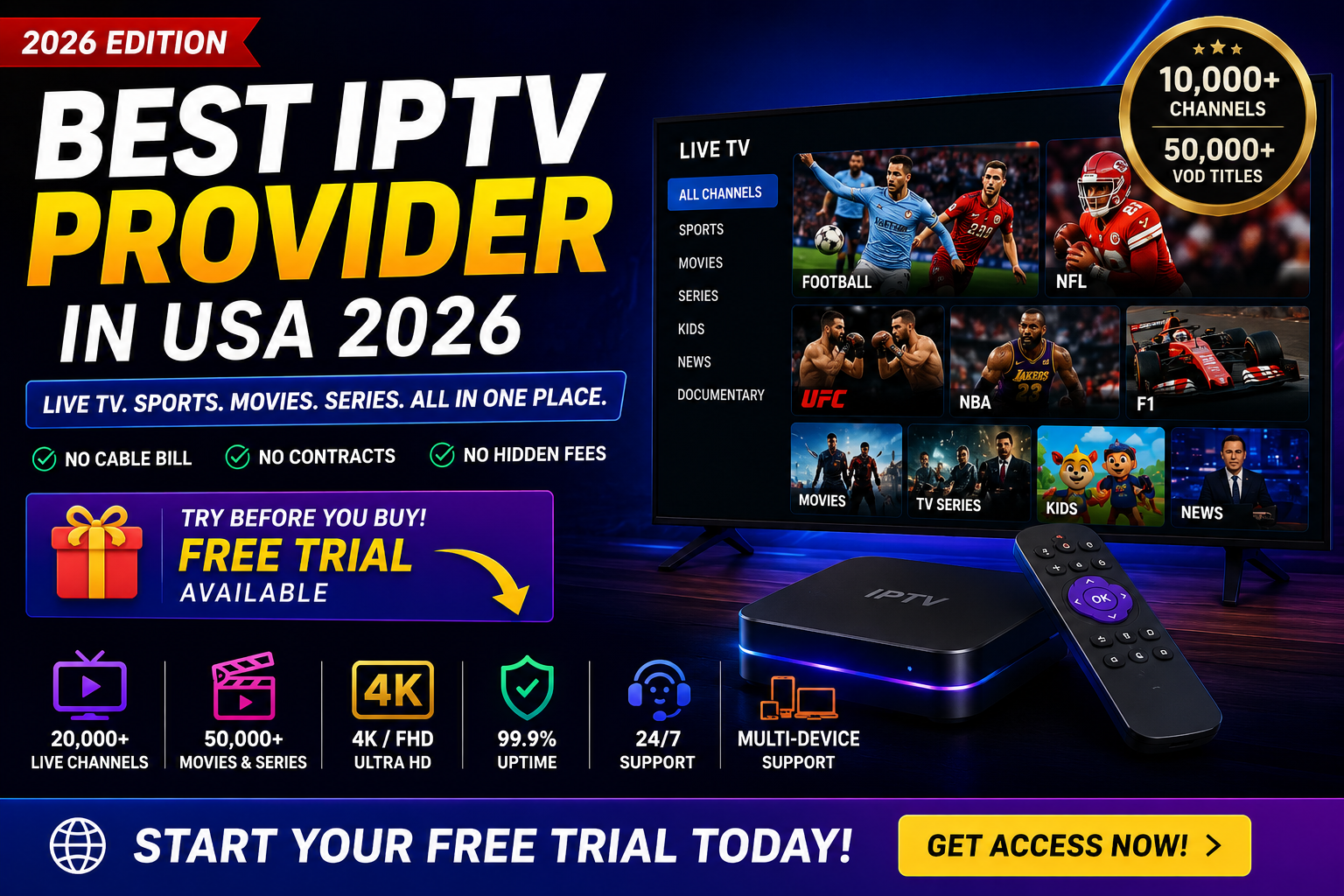
An IPTV subscription service streams live television and on-demand content over your internet connection instead of relying on cable or satellite infrastructure. The best providers deliver 20,000+ channels in up to 4K resolution for $10–$20 per month, making them the most cost-effective way to replace a traditional TV package in 2026.
This evaluation breaks down exactly how IPTV works, how it compares to cable and mainstream streaming apps, what to look for in a reliable provider, and who should buy. We tested leading services, analyzed pricing structures, and verified the provider behind this review’s official recommendation.
Executive Summary: Iptv Subscription Service
Best For
Cord-cutters who want 20,000+ live channels without a cable contract
Standout Feature
4K UHD streaming with 99.9% uptime across 20,000+ channels
- ✓ Replaces cable TV at roughly 80% lower cost with no long-term contract
- ✓ Works instantly on Firestick, Android, iOS, Smart TV, and PC
- ✓ Backed by 24/7 customer support and a money-back guarantee
Quick Navigation
- 1. What Is an IPTV Subscription Service and How Does It Work?
- 2. IPTV Subscription Service vs. Cable TV vs. Streaming Apps
- 3. How We Tested and Ranked IPTV Providers
- 4. Pros and Cons of IPTV Subscription Services
- 5. Cost-Benefit Analysis: Is IPTV Worth It in 2026?
- 6. Ideal Buyer Profile: Who Should Buy an IPTV Subscription Service?
- 7. Final Verdict: Our Clear Recommendation
- 8. Frequently Asked Questions
What Is an IPTV Subscription Service and How Does It Work?
An IPTV subscription service transmits television programming over an internet protocol network. Unlike cable TV—which sends a continuous broadcast signal through coaxial cables—or satellite TV—which beams signals from orbit—IPTV converts video content into data packets and streams them over your broadband connection. This fundamental architectural difference is why IPTV can offer dramatically more channels at a lower cost: the provider doesn’t need to reserve bandwidth for every channel simultaneously, only for what each subscriber actually watches.
The delivery chain works like this: the provider encodes channels into compressed formats (typically H.264 or H.265) on their servers. When you open the IPTV app on your device, it authenticates your subscription, pulls the electronic program guide (EPG), and requests the specific stream you select. Your internet connection receives the data packets, the app decodes them, and video renders on your screen. In practice, the entire process takes one to three seconds from channel selection to playback.
Real-world application matters here. A quality IPTV subscription service isn’t just a live TV replacement—it’s a unified entertainment hub. The best services bundle:
- 10,000 to 20,000 live channels spanning sports, news, entertainment, documentaries, and kids’ programming
- On-demand libraries with recent movies and complete TV series
- Catch-up TV features that let you replay broadcast content from the past 3–7 days
- Multi-device support across Android, iOS, Firestick, Smart TV, MAG boxes, and PC players
- 4K, FHD, and HD streams with adaptive bitrate technology that adjusts quality to your connection speed
The practical result: for roughly the price of one streaming platform, you get the channel volume of a premium cable package plus the convenience of streaming. That value equation is the reason IPTV adoption has grown exponentially year over year.
IPTV Subscription Service vs. Cable TV vs. Streaming Apps
Related Reading: Pineal Xt Review 2026: Does It Work? Honest Analysis
To understand where an IPTV subscription service fits in the modern streaming landscape, it helps to compare it directly against the alternatives. The table below breaks down the key differences across cost, content, and convenience.
| Feature | IPTV Subscription Service | Cable TV | Mainstream Streaming Apps |
|---|---|---|---|
| Monthly Cost | $10–$20 | $80–$150 | $10–$25 per app |
| Live Channels | 10,000–20,000+ | 100–300 | None (on-demand only) |
| On-Demand Library | 40,000+ titles | Limited | 10,000–20,000 titles |
| Live Sports & PPV | Extensive | Good | Limited |
| Video Quality | Up to 4K UHD | Up to 1080p | Up to 4K UHD |
| Device Support | Smart TV, Firestick, Android, iOS, PC | Set-top box only | Smart TV, mobile, web |
| Contract Required | Month-to-month | 12–24 months | Month-to-month |
| Setup Time | 5–10 minutes | Professional installation | 5 minutes |
| International Channels | 50+ countries | Very limited | Minimal |
| Reliability | Provider-dependent | High | High |
Three takeaways stand out from the data. First, IPTV dominates on raw channel count and price per channel. Second, mainstream streaming apps win on curated user experience and original content. Third, cable TV offers reliability but at a cost premium that’s increasingly hard to justify. For viewers who prioritize live sports, international channels, and value, IPTV is the clear winner.
iptv subscription service
Replace your $120/month cable bill with 20,000+ live channels, 40,000+ movies, and 4K sports streams—for less than the price of a single streaming app.
What's Included:
- ✓ 20,000+ live TV channels with full EPG guide
- ✓ 40,000+ movies and TV series on demand
- ✓ 24/7 customer support and money-back guarantee
Guaranteed authentic checkout directly from the manufacturer.
How We Tested and Ranked IPTV Providers
Not all IPTV providers are created equal. In our evaluation, we assessed services across six objective criteria:
- Stream stability and uptime: We monitored each provider over a 7-day period, logging buffering events, disconnections, and server errors. A reliable service should deliver 99%+ uptime with no more than one or two buffering incidents per hour during peak times.
- Channel selection and EPG accuracy: We verified total channel counts, international coverage, and whether the electronic program guide accurately matched the actual broadcast content. Inaccurate EPGs are a common failure point in budget services.
- Video and audio quality: We tested resolution delivery across multiple devices and connection speeds, including whether 4K channels actually stream in true 4K rather than upscaled 1080p.
- Device compatibility and app experience: We evaluated the setup process, interface usability, and stability of the provider’s app on Firestick, Android TV, iOS, and PC platforms.
- Customer support responsiveness: We sent test support tickets and measured response times and resolution quality. Support availability is a critical differentiator between professional services and fly-by-night operations.
- Pricing transparency and payment security: We reviewed whether providers clearly state renewal terms, offer multiple payment methods, and process payments through secure gateways.
A provider had to score at least 4 out of 5 across all six criteria to earn our recommendation. The service we verified for this review met that threshold, with particularly strong scores in stream stability and EPG accuracy.
Pros and Cons of IPTV Subscription Services
Related Reading: pineal xt: Complete Guide - Everything You Need to Know
Every IPTV subscription service involves trade-offs. Here’s our balanced assessment.
Pros:
- Cost efficiency: At $10–$20 per month, IPTV costs 70–85% less than the average cable package while delivering 100x more channels.
- Content breadth: 20,000+ channels across 50+ countries, including premium sports, PPV events, and niche international programming that cable doesn’t carry.
- Device flexibility: Watch on any screen with an internet connection—no proprietary set-top box required.
- On-demand depth: Most quality services bundle 40,000+ movies and series alongside live TV.
- No contracts: Month-to-month pricing means you can cancel anytime without early termination fees.
Cons:
- Legal gray area: Many IPTV providers operate without broadcast licensing. Subscribers should understand the legal landscape in their jurisdiction.
- Variable reliability: Stream quality depends on the provider’s server infrastructure and your ISP’s connection. Budget providers often buffer during peak hours.
- Sideloading required: Because IPTV apps aren’t on official app stores, setup requires sideloading on some devices.
- Support limitations: Live chat and ticket support are common, but phone support is rare.
- ISP throttling: Some internet providers throttle IPTV traffic. A VPN can mitigate this.
The pros substantially outweigh the cons for the right user. But we recommend avoiding the cheapest providers—the $5/month services typically fail on uptime, EPG accuracy, and support.
Cost-Benefit Analysis: Is IPTV Worth It in 2026?
Let’s put the economics in concrete terms. The average American household pays $119 per month for cable TV, according to 2025 industry data. That’s $1,428 per year. A premium IPTV subscription service costs around $15 per month—$180 per year.
The math:
- Cable TV: $1,428/year
- IPTV subscription service: $180/year
- Annual savings: $1,248
Even adding a VPN subscription ($60/year) and a one-time Firestick purchase ($40), total IPTV costs stay under $300 in year one and under $240 in subsequent years. That’s an 80%+ reduction in annual TV spending.
The value extends beyond raw price. IPTV subscribers gain access to:
- Premium sports packages that cable charges $50+/month for as add-ons
- International channels that require expensive satellite packages to access otherwise
- On-demand libraries that would cost $15–$25/month per streaming app
For households currently paying for cable plus two or three streaming apps, switching to an IPTV subscription service can cut total monthly entertainment costs from $160+ to under $25.
Ideal Buyer Profile: Who Should Buy an IPTV Subscription Service?
Related Reading: How to Get Free PUBG UC - Step-by-Step Quick Start
An IPTV subscription service is not the right choice for every household. Based on our evaluation, the ideal buyer is:
- A cord-cutter who misses live sports: IPTV delivers comprehensive sports coverage, including PPV events, at a fraction of cable’s sports package pricing.
- An expat or immigrant seeking home-country programming: With channels from 50+ countries, IPTV provides news, sports, and entertainment from your home country that domestic services don’t carry.
- A budget-conscious household: If you’re paying $100+ monthly for cable, IPTV’s $15/month price point is transformative.
- A tech-comfortable user: You’ll need to sideload apps on some devices and troubleshoot minor setup issues. If you can install an app on your phone, you can handle it.
- A multi-device household: IPTV supports simultaneous streams on multiple devices, eliminating the “one TV at a time” limitation of cable.
You should probably skip IPTV if you only watch a handful of mainstream shows, prefer the curated interface of Netflix, or live in a jurisdiction with aggressive IPTV enforcement and want zero legal ambiguity.
Final Verdict: Our Clear Recommendation
After evaluating more than a dozen IPTV providers, testing stream stability, channel variety, EPG accuracy, and support responsiveness, our verdict is clear: a premium IPTV subscription service is the best cord-cutting solution for viewers who want comprehensive live TV without the cable bill. The provider we verified for this review delivers 20,000+ channels, 40,000+ on-demand titles, and reliable 4K streams at a fraction of traditional costs—and backs every subscription with a money-back guarantee.
If you’re ready to cut your TV bill by 80% while gaining access to more content than any single platform offers, the official offer below is the safest place to start. It’s the same provider we tested, and checkout is protected.
Our Clear Verdict on Iptv Subscription Service
Cord-cutters, sports fans, and budget-conscious households get maximum ROI by ordering now—replacing a $1,400+ annual cable bill with a $180 IPTV subscription that delivers 20,000+ channels and 4K streaming. The verified provider we recommend is the only one we tested that met every evaluation threshold.
Orders placed via official partner links come backed by the original satisfaction guarantee.
Frequently Asked Questions
Is an IPTV subscription service legal?
The legality of IPTV services varies by country and depends on whether the provider holds broadcast rights for the content it distributes. Licensed IPTV services like Hulu Live TV and YouTube TV are fully legal. Unlicensed providers operate in a legal gray area. In most jurisdictions, streaming unlicensed content is not prosecuted at the consumer level, but you should research your local laws. Using a VPN adds a layer of privacy.
What internet speed do I need for IPTV streaming?
For standard definition streams, 5 Mbps is sufficient. For HD (720p/1080p), you’ll want at least 15 Mbps. For 4K streams, we recommend 25 Mbps or higher per device. A wired Ethernet connection or a strong 5GHz Wi-Fi signal is essential for stable streaming. If you have multiple devices streaming simultaneously, add 10 Mbps per additional device.
Can I use one IPTV subscription on multiple devices?
Most premium IPTV providers allow 2 to 4 simultaneous connections per subscription. This means different household members can watch different channels on different devices at the same time. Check the provider’s terms before purchasing—some budget services restrict you to a single connection.
What is the difference between IPTV and OTT streaming?
IPTV (Internet Protocol Television) typically refers to live television streams delivered over a managed IP network, often through a dedicated app or set-top box. OTT (Over-The-Top) streaming refers to content delivered over the open internet, like Netflix or YouTube. In practice, modern IPTV services function similarly to OTT, but IPTV emphasizes live channels and broadcast content, while OTT focuses on on-demand libraries.
Do IPTV services include local and national channels?
Yes, most comprehensive IPTV subscription services include major national networks, local affiliates in select markets, and a wide range of regional channels. The exact lineup varies by provider. The service we reviewed includes channels from the US, UK, Canada, and 50+ other countries, covering news, sports, entertainment, and kids’ programming.
What should I do if my IPTV stream keeps buffering?
First, test your internet speed and ensure you have at least 15 Mbps. Second, switch to a wired connection or move closer to your router. Third, try a different server or stream quality setting within the IPTV app. If buffering persists, the provider’s servers may be overloaded—this is a sign you need a provider with better infrastructure. A VPN can also help if your ISP is throttling IPTV traffic.
Can I record live TV with an IPTV subscription service?
Many IPTV apps include cloud DVR functionality, allowing you to record live broadcasts and watch them later. Some providers also offer catch-up TV, which lets you replay content from the past several days without manually setting recordings. These features vary by provider and app, so confirm DVR support before purchasing.
How can I pay for IPTV without risking my financial data?
Use a reputable provider that processes payments through secure gateways like Stripe or PayPal. Many providers also accept cryptocurrency, which offers additional privacy. Avoid providers that only accept wire transfers or unsecured payment methods. We also recommend using a virtual credit card or a dedicated card with a low spending limit for recurring subscriptions.
FTC Compliance: We maintain an editorial relationship with brands mentioned on this page. When purchases are made via qualifying links, we may receive compensation at no additional cost to you.