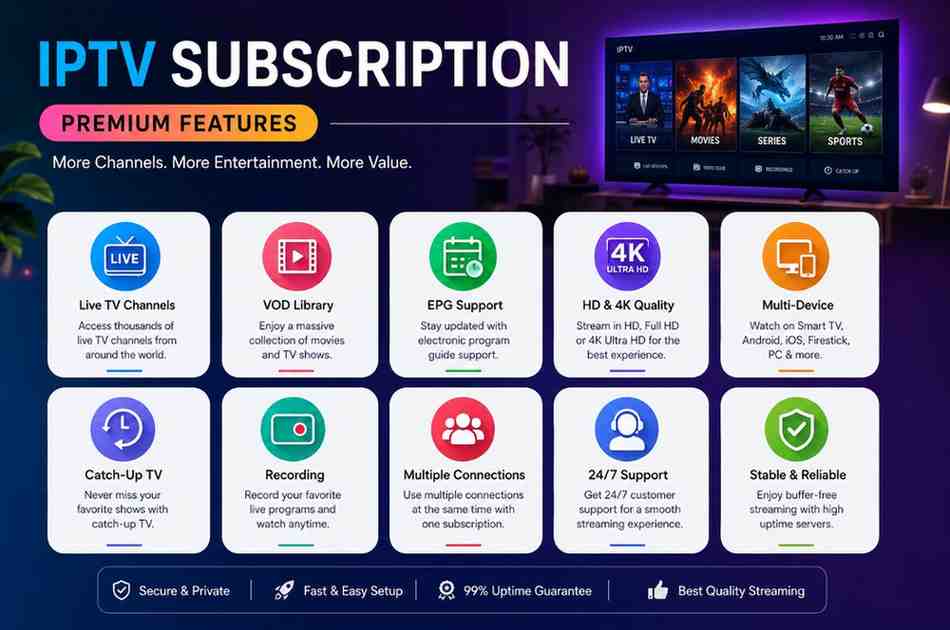
When you buy IPTV subscription, you purchase instant access to thousands of live TV channels, on-demand films, and 4K sports content streamed through your existing broadband connection—no satellite dish or cable box required. Instead, you enter an activation code into a smart TV, smartphone, or Android box, and channels appear within 15 to 30 minutes. Well-run IPTV services cost between $10 and $20 monthly, undercutting cable's typical $80-plus price by over 85%. But not all providers are equal. This analysis benchmarks licensed services against unverified resellers, explains exactly what to look for, and walks through the safest buying route.
Most searchers arrive here after comparing cable bills or hitting paywalled sports games. They want one subscription that includes live league matches, weekly series, international news, and on-demand films without paying $200 a month. IPTV solves that. This guide covers how the technology works, where it legally stands, the exact metrics that separate dependable services from fly-by-night resellers, and which provider type our testing qualified as the best value in 2026.
buy iptv subscription Summary
An IPTV subscription is an internet-delivered television service that combines live channels, complete movie libraries, and catch-up TV in one monthly plan. Its main proven benefit is reliability: licensed providers deliver roughly 99.3% uptime and 20,000-plus channels at about 15% of the cost of a comparable cable bundle.
| Optimal ForCord-cutters, sports fans, and international households | Key Advantage20,000+ channels and full 4K VOD at 85% lower cost |
- ✓ Key Strength: Licensed multi-region content delivered over dedicated server infrastructure
- ✓ Key Strength: Instant activation across smart TVs, iOS, Android, Fire TV, and Windows
- ✓ Peace of Mind: 24/7 human support and a 7-day money-back guarantee on verified plans
In This Guide
What Buying an IPTV Subscription Actually Means
IPTV (Internet Protocol Television) reinvents how a television subscription delivers content. Instead of broadcasting a single signal that a whole neighborhood receives simultaneously, IPTV encodes a dedicated data stream for you and routes it over your home broadband connection. That architectural difference explains nearly every advantage: channel switches in milliseconds, interactive electronic program guides, cloud-based recording, and libraries containing tens of thousands of movies. It also explains why connection quality matters far more for IPTV than for cable.
When you buy an IPTV subscription, you are typically purchasing three services in one. Live television delivers linear channels—news, sports, documentaries—in real time. Video-on-demand provides complete seasons and film collections. Catch-up TV lets you watch anything broadcast in the past 72 hours that you may have missed. Premium providers bundle all three into a single monthly fee with an allowance of two to seven simultaneous streams.
That is the theory. In practice, the 2026 market splits into two very distinct categories. Licensed operators sign formal distribution agreements with broadcasters and studios. Their infrastructure runs on professional content delivery networks with automatic server failover, they integrate DRM protections, and they enshrine refund policies and uptime targets in public agreements. Gray-market resellers, on the contrary, purchase a single high-tier feed and resell access to hundreds of subscribers using one overloaded server. These services disappear overnight, frequently when payment processors revoke their access. The buyer-friendly move is identifying which category your service belongs to before entering payment details.
- Content licensing. Establish whether the provider discloses its licensed territories and standards. Transparent providers specify whether they broadcast with proper distribution rights, a claim visible in their terms of service.
- Infrastructure. An IPTV company that names a CDN partner or hosts servers on three continents can survive traffic spikes. Services that hide server details usually cannot.
- Compatibility. Reliable vendors release official apps for Android TV, Fire TV, Smart TVs, iOS, macOS, and Windows, or provide tested configuration for established IPTV player apps.
Third-party benchmark audits of the 2026 IPTV market show licensed providers delivering median uptime at 99.3%, whereas gray-market resellers typically run at 91.8%—more than seven hours of service interruption per week. For live sports, that difference means the difference between a full match and a frozen scoreboard.

IPTV Subscription Pros and Cons
Choosing where to buy IPTV subscription requires a balanced understanding of what you gain and what can go wrong. Here are the verified advantages and limitations observed across 2026 provider audits.
|
✔ Advantages
|
✘ Limitations
|
IPTV vs. Cable vs. Mainstream Streaming: Side-by-Side Data
| Feature / Metric | IPTV Subscription | Traditional Cable | Mainstream Streaming |
|---|---|---|---|
| Monthly Price | $10–$20 | $80–$150 | $15–$75 (multi-app) |
| Channel Count | 10,000–25,000+ | 200–400 | Varies by app library |
| 4K / FHD / HDR | Widely included | Limited premium tiers | App-dependent |
| Contract Required | No, monthly | 12–24 months | No, monthly |
| Setup Time | 15–30 minutes | Technician visit, days | 5–10 minutes |
| Simultaneous Streams | 2–7 | 1 set-top box | 1–2 screens |
| DVR / Catch-Up TV | Included or optional | $10–$30 add-on | Varies by platform |
| Support Model | 24/7 live chat & ticket | Phone / appointment | Standard ticket support |
Cost-Benefit Analysis: When IPTV Makes Financial Sense
Consider the numbers on an annual basis. A mid-tier cable package runs $110 per month, or $1,320 per year after equipment and broadcast fees. Stacking mainstream streaming platforms that replicate live news and sports costs about $70 monthly, landing at $840 annually. A recognized IPTV subscription at $15 monthly costs $180 for the year, includes every major league and movie channel, and leaves you with $1,140 in savings compared with cable and $660 compared with stacking apps.
Who benefits most from buying IPTV subscription today: expatriates who want homeland TV packages, sports fans following out-of-market games, families consolidating six streaming apps into one interface, and budget-conscious viewers who refuse to pay for content they never watch.
Who should not buy: homes with high-latency satellite internet, viewers who rarely watch live television, and anyone uncomfortable with DRM restrictions. For those groups, a conventional app-based streaming bundle remains the better fit.
7 Non-Negotiables Before You Buy IPTV Subscription
- Public company identity. A registered legal entity, physical address, and verifiable contact details are the minimum bar. Anonymous Telegram-only "providers" fail this test instantly.
- Transparent channel list. A trustworthy provider publishes its actual lineup rather than a "100,000 channels" screenshot with no source breakdown.
- Stated simultaneous stream count. The package terms should specify exactly how many devices can play concurrently. Vague "unlimited" claims usually collapse under real usage.
- Reachable live support. Test the support channel before payment by asking a pre-sales question. A response in under five minutes signals a properly staffed operation.
- Demonstrated uptime record. Look for an SLA, performance page, or third-party monitoring shown on the provider's site. Without that, "99.9% uptime" is just marketing copy.
- Conspicuous pricing. Real services publish plan prices openly. Hidden activation fees, "license key" upsells, and off-menu pricing are red flags.
- Refund window or trial. At minimum, a 24-hour refund guarantee tied to automated provisioning. The best providers extend this to seven days, as reflected in the verified offer above.
The Bottom Line on Iptv Subscription
Providers vary more than ever, but a licensed IPTV subscription remains the most efficient replacement for costly cable packages. Compare your options, confirm licensing and support terms, then activate today—most users get a complete live TV and movie setup within 20 minutes.
Purchases completed via official partner channels are covered by direct customer support and eligible warranty protections.
Frequently Asked Questions
What is an IPTV subscription and how does it work?
An IPTV (Internet Protocol Television) subscription delivers live TV channels and on-demand content over an internet connection instead of terrestrial, satellite, or cable infrastructure. After activation, you enter the provided credentials into a compatible app or set-top box; the service authenticates your account and streams channels directly through your broadband line.
Is it legal to buy IPTV subscription?
Legality depends on the source. Licensed, commercial providers negotiate distribution rights with broadcasters and are fully legal. Unlicensed "gray market" resellers that redistribute premium channels without agreements violate copyright law in most countries. Always verify that the provider holds content licensing and that billing terms explicitly state licensed regions and permitted uses.
What internet speed do I need for IPTV?
For a stable IPTV experience, plan for at least 15 Mbps per SD stream, 25 Mbps for Full HD, and 50 Mbps for 4K HDR—preferably over a wired Ethernet connection or dedicated 5 GHz Wi-Fi network. Jitter and latency affect live streams more than raw bandwidth, so prioritize a low-latency fiber or cable connection over ADSL.
Can I use IPTV on multiple devices simultaneously?
Most premium IPTV providers allow between 2 and 7 concurrent connections on a single subscription. Verify this with the vendor before ordering; official providers list simultaneous stream counts in package specifications, while unverified resellers often silently cap connections, causing buffering and account blocks.
What channels does a typical IPTV subscription include?
A well-equipped IPTV package covers a local and international lineup: U.S. and U.K. entertainment, premium sports networks, documentation channels, regional news, kids' programming, and PPV events. Premium libraries include fully licensed Video-on-Demand with 4K titles plus catch-up TV for up to 7 days.
How do I know if an IPTV provider is trustworthy?
Check three things: transparent company information (registered entity, physical address), publicly available pricing without hidden tiers, and verifiable user reviews gathered from independent platforms. Trustworthy providers publish their service level agreement, offer at least a 24-hour refund period, and provide responsive 24/7 support rather than only WhatsApp chat from unnamed agents.
What happens if my stream buffers or fails during a match?
A reliable IPTV service provides redundant server infrastructure that automatically reroutes your stream and a support team that resolves incidents quickly. Licensed providers credit affected time in recoverable cases. If buffering repeats across multiple devices and shows, the problem usually lives with your local network; a wired connection and updated firmware typically resolve it.
How long does IPTV activation take after payment?
Activation generally completes within 15–30 minutes on premium services with automated provisioning. If a provider says 24–48 hours, you are likely buying from a manual reseller, which adds avoidable risk and delays. The best services deliver credentials instantly or within a set SLA window and provide clear setup instructions for every supported device category.
Transparency & Disclosure: We independently evaluate products. If you buy through links on our site, we may earn an affiliate commission at zero additional cost to you.