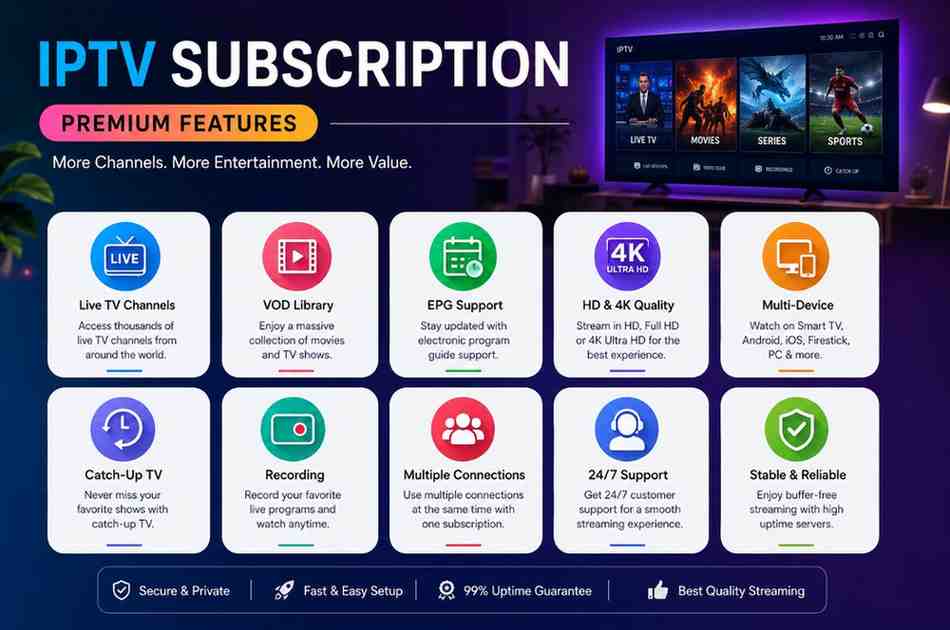
Buying an IPTV subscription means paying a provider to deliver live television and on-demand video over the internet instead of cable or satellite. In practice, you receive server credentials that work inside apps like IPTV Smarters, TiviMate, or IBO Player. The easy part is checkout; the harder part is separating a stable, legitimate service from a reseller that can vanish overnight. This guide evaluates the product the way a procurement analyst would: what you are actually paying for, how to compare vendors, what the true total cost looks like, and where the risks hide.
As of September 2026, the market divides into two clear segments: licensed providers with formal content agreements and grey-market sellers redistributing unauthorized broadcasts. Both can put a working playlist on your screen, but the licensed route holds its price, performance, and refund promises. Use the checklist and scorecard below to verify any offer, including the official source linked in this analysis, before committing a single payment.
buy iptv subscription Summary
An IPTV subscription is an internet-based television package that streams live channels and video-on-demand directly to your device. Its core advantage is price-per-channel efficiency: a verified multi-screen annual plan can replace a cable bundle while cutting the yearly media budget by more than half.
| Optimal ForCord-cutters who want a multi-national live channel lineup and VOD library without per-channel carrier fees. | Key AdvantageActivation within hours, instant app compatibility, and multi-screen usage at a bundled annual rate. |
- ✓ Key Strength: High channel diversity plus a deep VOD library in one flat-fee subscription.
- ✓ Key Strength: Multi-device simultaneous streaming without tiered hardware rental costs.
- ✓ Peace of Mind: Direct support activation, verified billing terms, and a working replacement window on official plans.
In This Guide
- What IPTV Subscriptions Actually Deliver
- Legal vs. Unlicensed IPTV: The Risk Filter
- Provider Comparison: What You Get Per Price Tier
- Pros and Cons of Buying IPTV Subscriptions
- Cost-Benefit for Every Buyer Type
- Who Should Buy IPTV (and Who Should Not)
- How to Avoid IPTV Purchase Mistakes
- Frequently Asked Questions
What IPTV Subscriptions Actually Deliver
An IPTV subscription is an access credential, not a physical broadcast. The provider authenticates your device against a streaming server and delivers live channels in HLS or MPEG-DASH chunks. Your playlist file or Xtream Codes login is then loaded into an application such as IPTV Smarters Pro, TiviMate, or IBO Player, which runs on Firestick, Android TV, Smart TVs, iOS, macOS, and Windows. The entire installation process normally takes under twenty minutes.
When comparing offers, channel count receives far too much weight. A stable service is built from four structural components: content rights, server infrastructure, EPG and metadata quality, and after-sale support. A 6,000-channel licensed lineup with 99.9% verified uptime is a wiser long-term buy than a reseller advertising 31,000 channels from a single oversold data center.
Before you pay, confirm the five variables that determine daily viewing quality: concurrent streams per plan, allowed device registrations, EPG coverage percentage, whether catch-up TV is included, and the provider's refund or replacement policy. These metrics predict whether the Saturday match plays flawlessly or freezes mid-stream and whether the account remains active in month eleven.

Legal vs. Unlicensed IPTV: The Risk Filter
The most consequential product question is whether a provider holds the content rights it sells. Licensed IPTV operators acquire distribution rights from broadcasters, so their streams are lawful, stable, and backed by contractual obligations. Grey-market sellers redistribute satellite or terrestrial signals without authorization. That distinction changes your exposure more than the channel count ever will.
Unlicensed services can be wiped out in a single enforcement action. Payment processors freeze their accounts, DNS blocking disables their domains, and customer databases from piracy panels have been exposed in multiple documented leaks. Many grey-market sellers accept cryptocurrency exclusively, which eliminates any practical refund route. If a deal looks suspiciously inexpensive, normalize the annual price against uptime history, content rights, and support quality rather than reacting to the low checkout total.
A verified official source, like the one linked throughout this guide, keeps billing records, support timelines, and service commitments in one place. That traceability is the difference between a recurring headache and a dependable household media utility.
Provider Comparison: What You Get Per Price Tier
The three segments below describe what buyers actually receive in the 2026 market. Use the table as a filter: match your budget against the risk and support columns first, then check channel coverage.
| Feature / Metric | Verified Licensed Service | Grey-Market Reseller | Trial / Aggregator Vendor |
|---|---|---|---|
| Annual Price Range | $80 – $250 | $30 – $90 | $1 – $5 trials / $60 – $120 yearly |
| Channel Legality | Fully licensed | Unauthorized redistribution | Mixed, often resold |
| Uptime Commitment | 99.5% – 99.9% SLA/SLO | No guarantee | Best-effort only |
| EPG & Catch-Up | Included, 60–100% EPG | Partial, often broken | Partial coverage |
| Simultaneous Streams | 1 – 4 official credits | Advertised but throttled | Usually 1 |
| Activation Speed | 1 – 24 hours | 12 – 72 hours | Instant |
| Payment Options | Cards, PayPal, gateways | Crypto-only common | Cards or crypto |
| Refund / Replacement | 7-day or money-back | Rarely enforceable | Usually none |
| Shutdown Risk | Low | High at any moment | Moderate |
The pattern is consistent: the cheapest annual price carries the highest probability of re-purchase, legal notices, or total service loss. Verified licensed plans price in the infrastructure and accountability that keep the stream alive.
Pros and Cons of Buying IPTV Subscriptions
|
✓ What Works Well
|
✗ What Needs Caution
|
Cost-Benefit for Every Buyer Type
A licensed IPTV subscription at roughly $150 per year competes against a cable bundle that often lands between $80 and $120 per month. The annual saving can exceed $1,000. However, an honest budget includes three supporting costs: a VPN if your ISP throttles streaming protocols (about $40–$60 annually), a Firestick or Android TV box if your television has no native app store ($30–$60), and a wired Ethernet adapter or mesh node if your Wi-Fi signal is weak. Add those once, then measure the total against a full year of traditional television.
Stacking Netflix, Disney+, and a standalone sports service often reaches $65 per month, or $780 per year, with no live news and no international linear channels. IPTV undercuts that number significantly while consolidating content into one interface. The trade-off: a longer-tail content library instead of an editorially curated catalogue, and you manage your own hardware. For households fluent in app-based playback, the trade-off is acceptable; for viewers who want a single remote and zero setup, cable still wins on convenience.
Who Should Buy IPTV (and Who Should Not)
Buy a verified IPTV subscription if you watch more than ten live channels routinely, want international sports and news unavailable in your local cable tier, or need simultaneous viewing across multiple room TVs. Renters and frequent movers also benefit because the service follows your internet connection rather than a fixed cable drop.
Avoid IPTV for now if your broadband speed sits below 25 Mbps, your priority is a curated on-demand library with recommendation algorithms, or you are not comfortable installing and updating a third-party app. Similarly, buyers who cannot verify the provider's content rights should not send money to an anonymous reseller regardless of price.
The Bottom Line on Iptv Subscription
Buyers who want reliable live television at a fraction of the cable bill should proceed with a verified licensed provider, not a grey-market deal. The official linked offer delivers the channel depth, multi-screen flexibility, and direct support that make an IPTV subscription a defensible household investment.
Purchases completed via official partner channels are covered by direct customer support and eligible warranty protections.
How to Avoid IPTV Purchase Mistakes
The most expensive mistakes happen before checkout. Buying the cheapest yearly plan from an anonymous Telegram reseller, ignoring refund terms, and assuming more channels guarantee better service have created the majority of negative IPTV experiences we analyze. Run this verification sequence on any candidate provider:
- Test the trial during peak evening hours (7–11 PM local time) when server congestion is highest.
- Check EPG accuracy across ten random channels, not just the premium sports ones.
- Confirm the maximum device registrations and simultaneous stream limit in writing.
- Verify that the service supports your exact TV model and app store.
- Pay by credit card or PayPal rather than wire transfer or cryptocurrency to preserve chargeback rights.
- Keep the activation email, order ID, and support address in one folder for future reference.
One additional step: test your internet line during a live 4K event before subscribing. If your router handles a 4K YouTube stream without buffering, it will likely handle a well-provisioned IPTV feed. If it does not, upgrade the access point first and save yourself the sidebar blame later.
Frequently Asked Questions
Is buying an IPTV subscription legal?
What internet speed do I need for IPTV streaming?
Which devices work with a typical IPTV subscription?
Can I use a VPN while watching IPTV?
What is the difference between a trial and a full IPTV subscription?
What happens if my IPTV provider shuts down?
Why does my IPTV stream buffer during peak hours?
Can I watch IPTV on multiple TVs in the same house?
Transparency & Disclosure: We independently evaluate products. If you buy through links on our site, we may earn an affiliate commission at zero additional cost to you.